Showing posts with label Printmaking. Show all posts

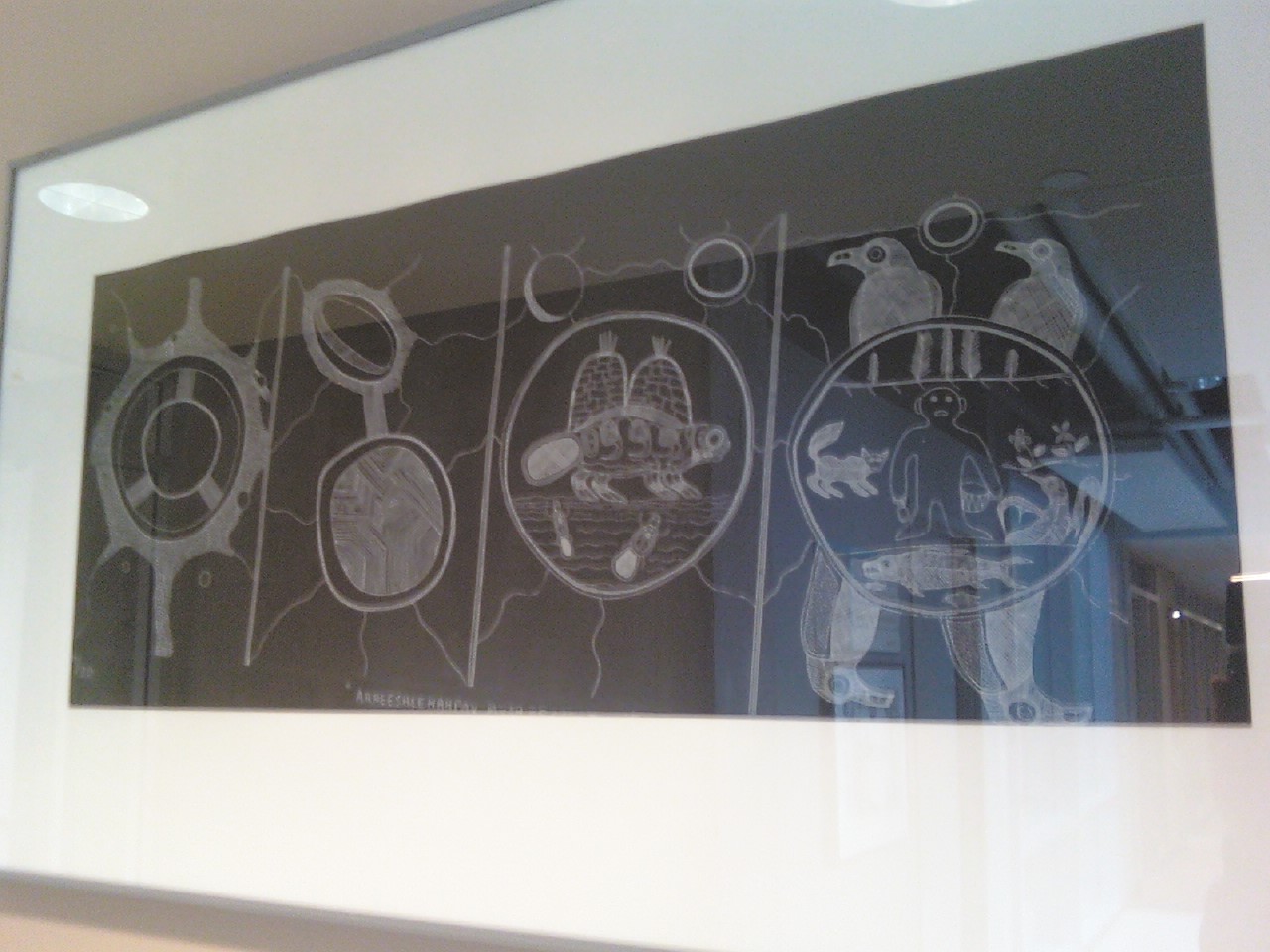
Angeconeb, Ahmoo

Ahmoo Angeconeb is a nationally and internationally celebrated Anishinaabe artist from the Lac Seul First Nation, near Sioux Lookout. He sites himself as being part of an Anishaabe visual tradition that comes from ancestors who have been creating art for thousands of years. He taught himself to paint at an early age; selling his first painting at 13 years of age. By the age of 22, Angeconeb had his first Toronto exhibition at York University where he was enrolled in the visual arts program.
He concentrates his artistic talent on printmaking. Angeconeb usually works on paper with etching-like figures that are both ancient and modern. His bold spiritual images are often presented in stark black and white codes.

His work has been displayed in shows and galleries in Europe, the United States, and Canada. Throughout his career as an artist, Angeconeb has also worked as an educator, teaching both children and adults about traditional and contemporary modes of art practice while educating them in the ways of the Anishinaabe.  He frequently lectures on Native art and has acted for the Ontario Arts Council as a consultant and judge for Native art.


Ahneesheenahpay / Myth of Creation
by
Angeconeb, Ahmoo (Allen)


Education
York University  
Lakehead University 
Dalhousie University

Collections
 
McMichael Canadian Collection
Museum Institute of Indian Art
Thunder Bay Art Gallery
University of Onsabruck
Woodland Indian Centre
Work Cited
http://www.ahnisnabae-art.com/ahnoo-angeconeb.html

Davidson, Robert

Robert Charles Davidson, also called Guud San Glans, is a Haida artist who was born November 4, 1946 in Hydaburg Alaska. He moved with his family to Massett on Haida Gwaii, Queen Charlotte Islands in 1947 and lived there until moving to Vancouver to pursue his education. It was in Vancouver that he first learned the fundamentals of silk-screening, drawing and design skills but it was not until 1966, when he began an eighteen month apprenticeship with Haida artist Bill Reid, that he launched his career as an artist.
Davidson constantly challenges himself to expand his knowledge and understanding of Haida art and culture. He has learned about Haida art from both living and ancestral Haida artists through his close community ties and work with museums and anthropologists. Davidson was surrounded by fine carving from an early age as his father Claude Davidson, Grandfather Robert Davidson Sr, and Great Grandfather Charles Edenshaw were respected carvers in Massett. Robert began carving during his early teens to carry on the family artistic tradition. Since that time, he has continued to explore the carved form in a variety of traditional and non-traditional media.
Robert Davidson was one of the first northwest coast artists to apply two dimensional design to limited edition prints. As a young artist he learned to cut his own screens and hand pull prints from them. His first editions were not numbered or signed. In 1970 he began numbering and signing his editions. He progressed from single color prints of traditional Haida crest designs to two color original images developed from his own work in wood and silver.
Davidson’s inquiry into Haida concepts of abstraction opens up the visual language, form, and tradition of Haida art. In his more recent work of the last decade, Davidson highlights shifts between abstract and representational images, often blurring the boundary between the two. Work opens up the discussion about the place of indigenous, community-based knowledge within the realm of contemporary art practice.
Grizzly Bear
by
Davidson, Robert
Education
Apprenticeship, Master Artist Bill Reid
Vancouver School of Art, Vancouver, BC

Selected Exhibitions
1971, Solo Exhibition, Vancouver Museum and Planetarium, Vancouver, BC
1978 Solo Exhibition,  Bent Box Gallery, Vancouver, BC

1979 Solo Exhibition, Cycles – The Graphic Art of Robert Davidson: A Retrospective, UBC Museum of Anthropology, Vancouver, BC
1980, Group Exhibition, The Heard Museum in Phoenix, Arizona
1982, Group Exhibition, Legacy – Contemporary BC Indian Art, BC Provincial Museum, Victoria, BC

1983, Solo Exhibition, Fachwerk Gallery in Bad Salzuflen, West Germany

1983, Group Exhibition, BC Arts and Artists 1931 – 1983, Vancouver Art Gallery, Vancouver, BC

1983, Group Exhibition, BC Printmakers, Victoria Art Gallery, Victoria, BC
1989, Group Exhibition, Collector’s Vision, Barrie Art Gallery, Barrie, Ontario

1989, Solo Exhibition, Eagle Song, The Derek Simpkins Gallery of Tribal Art, Vancouver, BC

1989, Group Exhibition, Masks, The Inuit Gallery, Vancouver, BC

1990, Group Exhibition, Meridian Gallery, San Francisco, CA
1993 Solo Exhibition, Eagle of the Dawn, The Vancouver Art Gallery, Vancouver, BC

1993, Solo Exhibition, Eagle of the Dawn, The Canadian Museum of Civilization, Hull, Québec
1999, Group Exhibition: Arrows of the Spirit, Mingei International Museum, San Diego, CA

2006 Group Exhibition, Raven Travelling: Two Centuries of Haida Art, Vancouver Art Gallery, Vancouver, BC
2006, Solo Exhibition, Robert Davidson:The Abstract Edge, McMichael Gallery, Toronto, On

Work Cited

Kakegamic, Joshim

Joshim Kakehamic was born in 1952 in Sandy Lake First Nation, Ontario. Influenced by his brother-in- law Norval Morrisseau, Kakegamic began to paint in his teens. Kakegamic preferred to work on smaller-scale pieces, creating complex imagery that engergized every inch of the surface. He developed his Woodland style of art while studying with Carl Ray and Morrisseau during their tour of northern reserves. Kakegamic eventually joined Morrisseau and Ray in the late1960s in demonstrating art in Ontario schools. He was included in a group showing in 1969, which was quickly followed by a solo workshop at Fanshaw College.
In 1973, after achieving recognition as a professional artist in his own right, Joshim Kakegamic partnered up with his brothers Goyce and Henry to found the Triple K silk screening Co-operative. The Co-operative was founded under the belief that Indigenous artists should control their own art production, from design conception to marketing of final product.  Operating under this mandate, Triple K distributed high quality silk screen prints to over 50 galleries across Canada, the United States, and Europe. The Co-operative was established in downtown Red Lake nearby the home of the artists and close to the origins of the Woodland School of art in North Western Ontario. This location was far away from southern Ontario and disrupted the prevailing belief that southern cities like Toronto were the core of the province’s strong art scene. In 1977, the Royal Ontario Museum recognized the importance of Triple K’s to the redefinition contemporary art centres by holding an exhibit of its silk screens.

During the 1970s and 1980s, Kakegamic took part in a number of his own solo and group exhibitions throughout Ontario, other sites in Canada, as well as on a group show "Woodland Indian Art Exhibition" at Canada House in London, England and Lahr, Germany. One of his major solo exhibitions took place at Toronto's Aggregation Gallery in 1977. His work remains in private and public collections in Canada and abroad.

Loon
by
Kakegamic, Josh

Untitled
by
Kakegamic, Josh

Collections
Royal Ontario Museum
Simon Fraser University Art Center
Canadian Museum of Civilization
McMicheal Canadian Art Collection
Thunder Bay Art Gallery

Work Cited

Saggashi, Fred

Works categorized as being a highly individualistic approach to Woodland Art style.


Unknown
by
Saggashi, Fred


Selected Exhibitions
1984, Waabanda-Iwewin Northwestern Ontaio Juried Indian Art Show, Thunder Bay National Exhibition Centre and Centre for Indian Art, Ontario, Canada.
Work Cited

Williams, Saul

Saul Williams was born on the peninsula at North Caribou Lake, Ontario in 1954. He began drawing and painting at a young age and by the summer of 1969 he sold his first painting for 5 dollars. Williams held his first art show at York University in 1971 and became a valued member of the Triple K Co-operative; an Indigenous controlled silk screening collective. His paintings are now held in the McMichael Gallery in Kleinberg and the Woodland Indian Cultural Education Centre in Brantford, Ontario; the Royal Ontario Museum, the New College in Toronto as well as many private collections in North America.
Williams paints for both internal and external audiences. On one level he see himself as a record keeper of his people’s beliefs and traditions, while at the same time on a whole other level he is painting to share knowledge that will help create mutual understandings between Indigenous and Non-Indigenous Peoples.  
Williams attributes much of his creative ability to his uncle, Mayo Quequish who was always drawing and creating cardboard replicas of airplanes and other objects seen in Ontario’s far north.  Williams liked this merger of art practices with the experience of personal daily life. Over the years he has combined artistic pursuit with a series of jobs: carpentry; firefighting, dockhand, art teacher in northern schools and school counsellor.


Seagulls
by
Williams, Saul


Work Cited