Showing posts with label Self-Taught. Show all posts

Angeconeb, Ahmoo

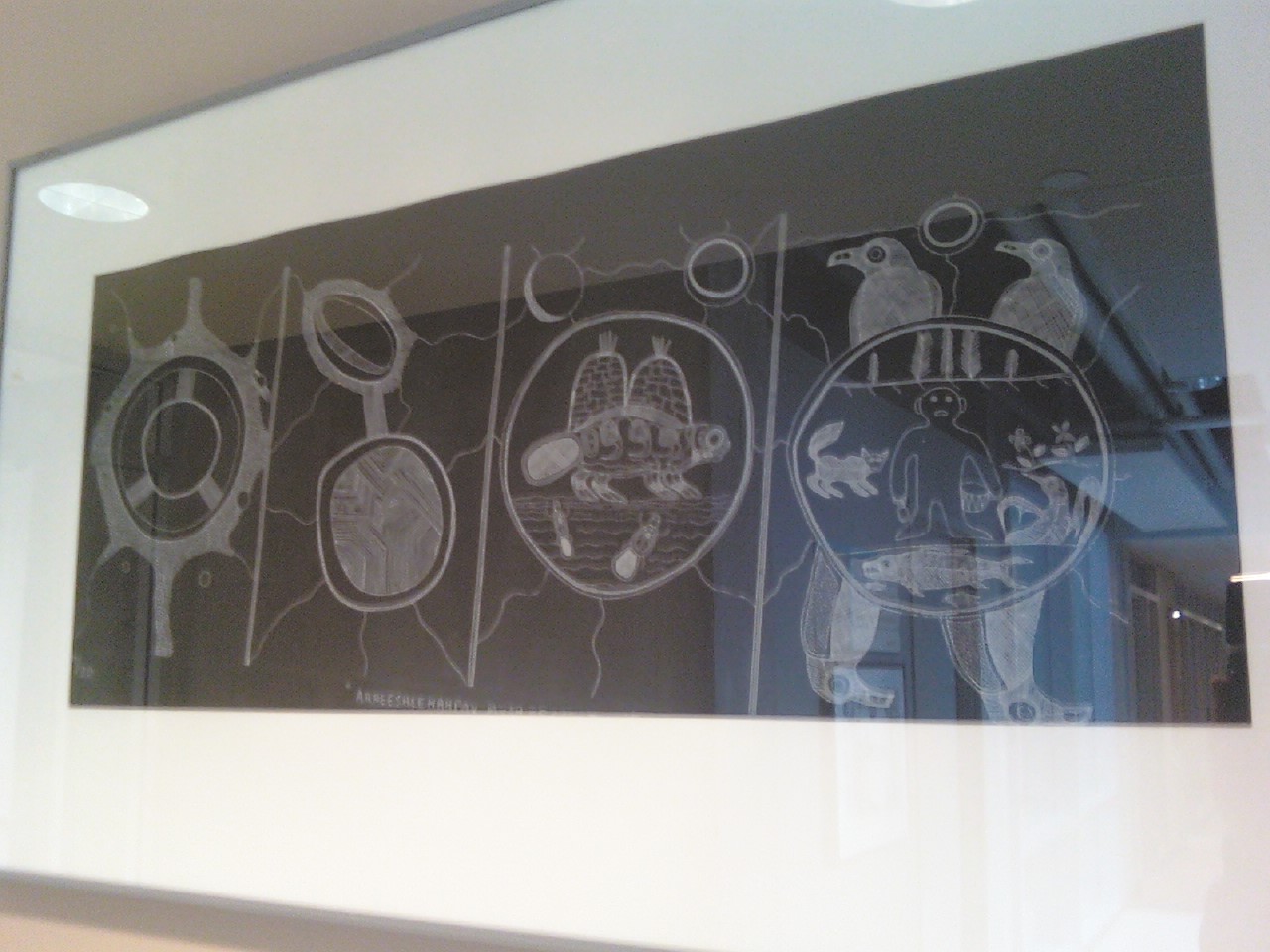
Ahmoo Angeconeb is a nationally and internationally celebrated Anishinaabe artist from the Lac Seul First Nation, near Sioux Lookout. He sites himself as being part of an Anishaabe visual tradition that comes from ancestors who have been creating art for thousands of years. He taught himself to paint at an early age; selling his first painting at 13 years of age. By the age of 22, Angeconeb had his first Toronto exhibition at York University where he was enrolled in the visual arts program.
He concentrates his artistic talent on printmaking. Angeconeb usually works on paper with etching-like figures that are both ancient and modern. His bold spiritual images are often presented in stark black and white codes.

His work has been displayed in shows and galleries in Europe, the United States, and Canada. Throughout his career as an artist, Angeconeb has also worked as an educator, teaching both children and adults about traditional and contemporary modes of art practice while educating them in the ways of the Anishinaabe.  He frequently lectures on Native art and has acted for the Ontario Arts Council as a consultant and judge for Native art.


Ahneesheenahpay / Myth of Creation
by
Angeconeb, Ahmoo (Allen)


Education
York University  
Lakehead University 
Dalhousie University

Collections
 
McMichael Canadian Collection
Museum Institute of Indian Art
Thunder Bay Art Gallery
University of Onsabruck
Woodland Indian Centre
Work Cited
http://www.ahnisnabae-art.com/ahnoo-angeconeb.html

Morrisseau, Norval

Norval Morrisseau, also known as Copper Thunderbird, is an Anishinaabe artist who was born in 1931 in Sandy Lake First Nation, near Thunder Bay, Ontario. He was brought up by his maternal grandfather Moses Potan Nanakonagos, a shaman who strongly influenced Morrisseau’s life and works.
Morrisseau began developing his artistic talent at a young age. During his youth he started drawing on rocks or in damp sand. These practises eventually gave way to early attempts at painting that used ink, pastels, and crayons on birch bark, brown paper, and cardboard. The result was a professional artistic process that attempted to transfer tradition to a new strategy and medium.
 In his approach to painting, Morrisseau assumed the drawing style from the Mide Scrolls and converted it to modern canvas. This style became known as the Woodland School of Art and has inspired the work of many subsequent Indigenous artists. Distinctive aspects of the style include: locating the action of the work within the people or figures featured, employing plain backgrounds, organically connection of figures, and bright bold use of colour with black outlines. His work came under considerable debate within Indigenous communities because many believed the sacred drawings and content of the Mide Scrolls was not intended to exist outside of the scrolls or be accessed outside of Anishinaabe circles. Morrisseau and his supporters maintain that his work is an essential process in maintaining links between cultural tradition, history and future generations.
Person with Hat
by
Morrisseau, Norval
In 1962, Morrisseau went to the Pollack Gallery in Toronto and offered to sell his painting on birch bark to owner and artist Jack Pollock. Pollock decided to commercially exhibit Morrisseau and in doing so would change the way the public understood Indigenous art and artists. This first show was a huge sensation and was followed by a long and successful public career as a contemporary artist.  Between 1963 and 1993, Morrisseau’s work was displayed in twenty-two group exhibitions and twenty-five solo exhibits between 1962 and 2001. His works continued to be featured in collections internationally.
Thunderbirds
by
Morrisseau, Norval

Education
A self-taught artist, Norval would subsequently be the recipient of several honourary degrees.
Selected Exhibitions
'Norval Morrisseau and the Emergence of the Image Makers' - Art Gallery of Ontario, 1984
Canadian Museum of Civilization, Ottawa, 1991
The Drawing Center, New York, 2000
Collections
Art Gallery of Ontario
McMichael Gallery
National Gallery of Canada
Red Lake Regional Heritage Centre
Work Cited
Seller, Amanda. “Profile of Noreval Morrisseau, (1932): Ojibwa, Artist, and Storyteller”.  Ed. Newhouse, David. Hidden In Plain Sight: Contributions of Canadian Aboriginal Peoples to Canadian Identity and Culture. Toronto: University of Toronto Press Inc, 2007.
  

Saggashi, Fred

Works categorized as being a highly individualistic approach to Woodland Art style.


Unknown
by
Saggashi, Fred


Selected Exhibitions
1984, Waabanda-Iwewin Northwestern Ontaio Juried Indian Art Show, Thunder Bay National Exhibition Centre and Centre for Indian Art, Ontario, Canada.
Work Cited

Thomas, Roy

Roy Thomas is an Anishinaabe artist who resided in Thunder Bay, Ontario. Without any formal training, Thomas cited the spirit of Anishinaabe elders and art as his teachers.
In the 1980s, art critics linked him with "the younger generation" of Woodland artists after Norval Morriseau and Daphne Odjig in a period bridged by Carl Ray. His strength lay in his design ability and his bold use of line and color. While his work has been classified as a Woodland style of art of bold colourations framed by black form lines, the focus of his pieces have always stressed content over style. He painted his experiences of the traditional cultural stories told to him by his grandparents. Thomas believed that his grandmother's spirit was present with him while he painted, and honoured her by signing his works with a small crow, the name she had given him.
He had numerous one-man exhibitions and participated in several group shows around the world. His work is represented in major Aboriginal Art Collections across Canada and in the US, Europe and Japan.

"Orange Bird, Big and Little"
by
Thomas, Roy

Education
Primarily Self-Taught
Exhibitions
Pollock Gallery (solo shows) 1977, 1978, 1979, 1980
The Image Makers, Art Gallery of Ontario, 1984
Thunder Bay Art Gallery (solo shows) 1983, 1989, 1991
Maslak McLeod Gallery, 1994
Royal Ontario Museum, 1996
Collections
National Gallery of Canada
Art Gallery of Ontario
Canadian Museum of Civilization, Ottawa
McMichael Canadian Collection, Kleinburg
Other major collections across Canada, the US, Europe and Japan.

Work Cited
http://www.ahnisnabae-art.com/roy-thomas.html

Williams, Saul

Saul Williams was born on the peninsula at North Caribou Lake, Ontario in 1954. He began drawing and painting at a young age and by the summer of 1969 he sold his first painting for 5 dollars. Williams held his first art show at York University in 1971 and became a valued member of the Triple K Co-operative; an Indigenous controlled silk screening collective. His paintings are now held in the McMichael Gallery in Kleinberg and the Woodland Indian Cultural Education Centre in Brantford, Ontario; the Royal Ontario Museum, the New College in Toronto as well as many private collections in North America.
Williams paints for both internal and external audiences. On one level he see himself as a record keeper of his people’s beliefs and traditions, while at the same time on a whole other level he is painting to share knowledge that will help create mutual understandings between Indigenous and Non-Indigenous Peoples.  
Williams attributes much of his creative ability to his uncle, Mayo Quequish who was always drawing and creating cardboard replicas of airplanes and other objects seen in Ontario’s far north.  Williams liked this merger of art practices with the experience of personal daily life. Over the years he has combined artistic pursuit with a series of jobs: carpentry; firefighting, dockhand, art teacher in northern schools and school counsellor.


Seagulls
by
Williams, Saul


Work Cited